Kearneys in the 1939 Register

Since my last post there has been another weekend of free access to the 1939 Register. I’ve enjoyed having free access and found quite a few new records to add to my collection. I’ll be sharing some of them here.

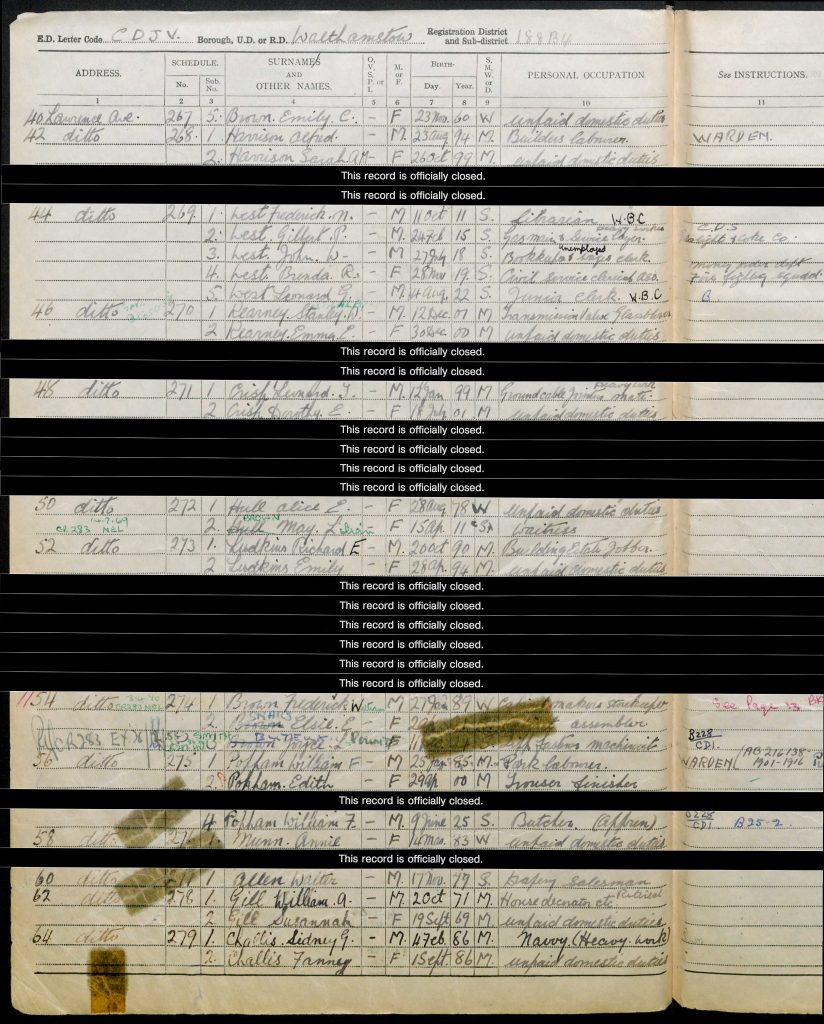
I haven’t done too much research to my husband’s family tree yet but I did discover where his paternal grandparents were living in 1939 – 44 Lawrence Avenue, Walthamstow, London.

Stanley Kearney’s occupation was a Transmission Valve Glassblower whilst his wife Emma did unpaid domestic duties. I think they had two children at home but these records are currently closed as they are both living.

I love that the page has been annotated with little snippets of information relating to war work. Sadly there are no additional facts for me.

Free access to the 1939 Register

A few days ago I received an email from Ancestry about free access to the 1939 Register. I was pretty excited about this as it gave me an opportunity to find out a bit more about where family members were living at this time.

Due to a severe lack of time I only managed 2 searches! Life has been pretty busy lately which means I hardly get any time to carry out any new research. However, I did find two records which add to building up the picture of my family.

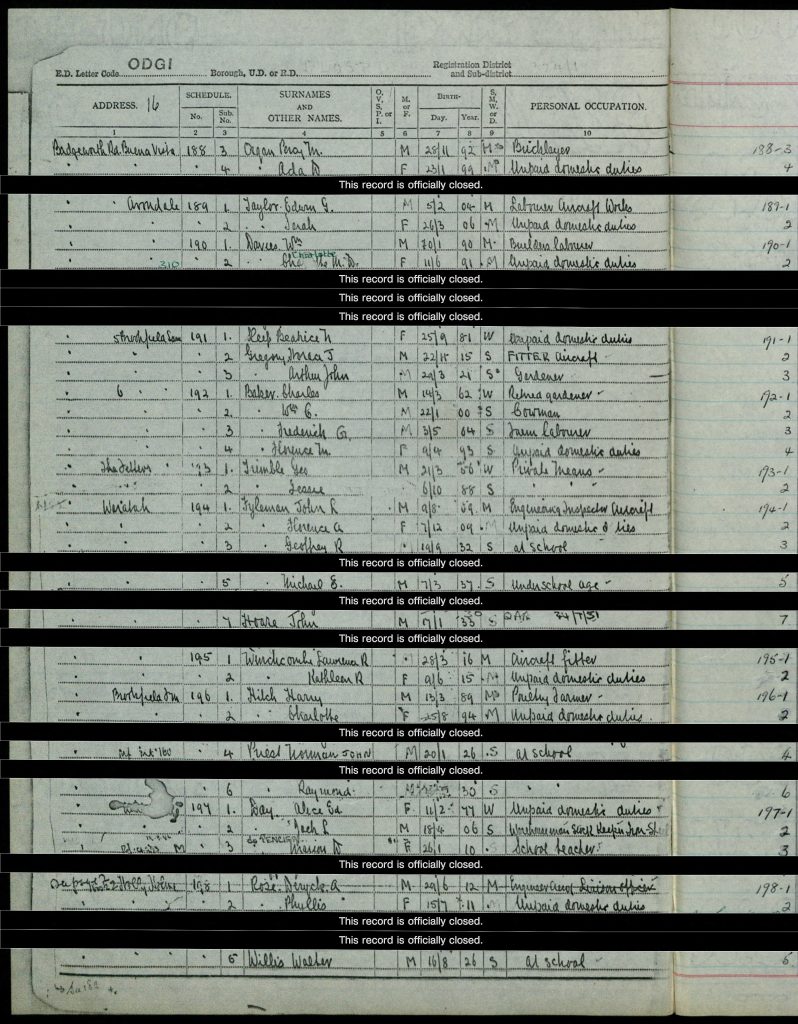
The first was of my maternal grandparents, Lawrence and Kathleen Winchcombe. His occupation is given as Aircraft Fitter whilst her occupation was listed as unpaid domestic duties.

They were living exactly where I knew they would be but I was still glad to be able to add this record to my collection.

British Royal Navy Allotment Declarations 1795-1852

New record sets have been announced from findmypast today. One of them was of interest to me as I have Royal Navy ancestors:

British Royal Navy Allotment Declarations 1795-1852 contains over 485,000 records held by The National Archives at Kew. Each record includes a transcripts that will reveal your ancestor’s rank, the year of their declaration, their pay book number, their relationship the recipient and any additional remarks. Images may reveal where and when they were married, the names, ages, and baptism dates of their children, the allotted individuals residence, the allotment date and where payable. Prior to 1853, men joined the navy on a short-term basis and service records were not created until after 1853. Allotment Declarations are an excellent way to trace the careers of your earlier naval ancestors.

You have to pay to access the records unfortunately but I have added this to my to-do-list.

The 1939 Register

I was recently sent a code to unlock a household record for free from the newly released 1939 Register at Find My Past. I would love to explore the 1939 Register but the cost of accessing the records has put me off. I understand that people invest a lot of money in digitising records and need to make money but I just don’t have any spare money for accessing these kinds of records at the moment.

Anyway, thanks to my free credit I was able to access one record. But which record to choose? I opted for my paternal grandparents as 1939 was the year before my father, their only child, was born. I knew they moved to Swindon at some point around this time so was interested to see where they were living.

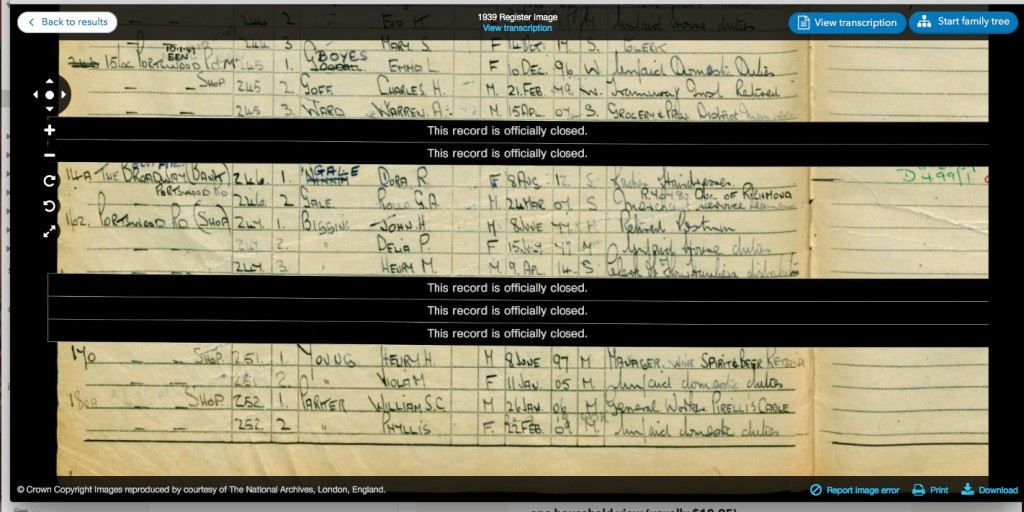
I searched for my paternal grandmother – Viola M Young. Her first name is quite unusual so she was easy to find and according to the site was living with her husband – Henry H Young in Southampton. I used my code to see the relevant page of the 1939 Register.

the 1939 Register

They were living at 170 The Broadway, Portswood Road, Southampton. As well as their dates of birth, the fact they were married, the 1939 Register gives their occupations. My paternal grandfather was Manager, Wine, Spirit and Beer Retailer. This record has been transcribed as Retired, but I think it says Retailer so have submitted a request to amend their record.

My grandmother has her occupation listed as Unpaid domestic duties.

It was really interesting to find this record but I don’t think it was worth the money that Find My Past are currently charging to access the records. Hopefully they will become cheaper and I will be able to use it soon.


Napoleonic Prisoner of War records

Today I’m sharing a press release from Findmypast which might be useful. To celebrate the 200th anniversary of the Battle of Waterloo, Findmypast has released thousands of fascinating new Napoleonic Prisoner of War records in partnership with The National Archives.

Prisoners of War 1715-1945 Phase 2 – Napoleonic Wars

Comprising over 71,000 entries, the new Napoleonic Prisoner of War records have been released in partnership with The National Archives. The release marks the second phase of a landmark project to make 250 years of British Foreign Office, Colonial Office, Admiralty and Air Force papers relating to the internment of allied and foreign Prisoners of War available to search online. These records form part of the wider Prisoners of War 1715-1945 collection and contain not only the details of members of the armed forces, but also of captured civilians and merchant seamen of various nationalities.

The new Napoleonic additions record the details of Danish, French, Prussian and American prisoners captured by British Forces during the Napoleonic Wars and the War of 1812. They list the prisoner’s name, nationality, rank, service number and the conflict in which they were captured. They can also reveal exactly when and where they were captured, where they were held, and many include full physical descriptions detailing hair colour, eye colour, build, complexion and any distinguishable marks. Records were also kept of the provisions and the supplies received by POWs such as blankets, clothing, and beds etc. providing incredible insights into the experiences of a Napoleonic prisoner of war.

Each record includes a transcript and an image of the original handwritten document. The amount of information in each record can vary depending on the type of document and the amount of detail recorded at the time of the event.

Nursing Research Topics

Normal 0 fake false false EN- US – X -NONE While in the course of handling it seems that a crap automotive is simply what it is basically usually known as “Refuse”, they have obtained a lot of automotive things that you can use for more uses. Several waste auto people as well as those who are captivated in acquiring crap autos from your common-people, often have try for independent automobile areas, where-in they distribute to gold small businesses, or maybe they put into utilize the car or truck parts on a unique cars, after striping the crap an automobile. Continue reading