A trip to Wimbledon

With a few recent new discoveries around London I thought it would be fun to visit some of these sites. I love researching my Mansel ancestors as they are so easy to find in historical records.

A trip to Wimbledon

Our first stop was Southside on Wimbledon Common. A few weeks ago I mentioned that this had been the home of Richard Mansel Phillips and his wife Caroline Bond Hopkins. Unfortunately their home was demolished and rebuilt on at a later date, but it was still good to see the site and the views over Wimbledon Common, it was certainly a lovely part of London.

The next stop was the church of St Mary in Wimbledon which was nearby. The churchyard is the burial place of William Mansell Philips of Coedgair (my third great-granduncle), his father-in-law Benjamin Bond Hopkins, and his benefactor John Hopkins, aka Vulture Hopkins.

church of St Marys Wimbledon

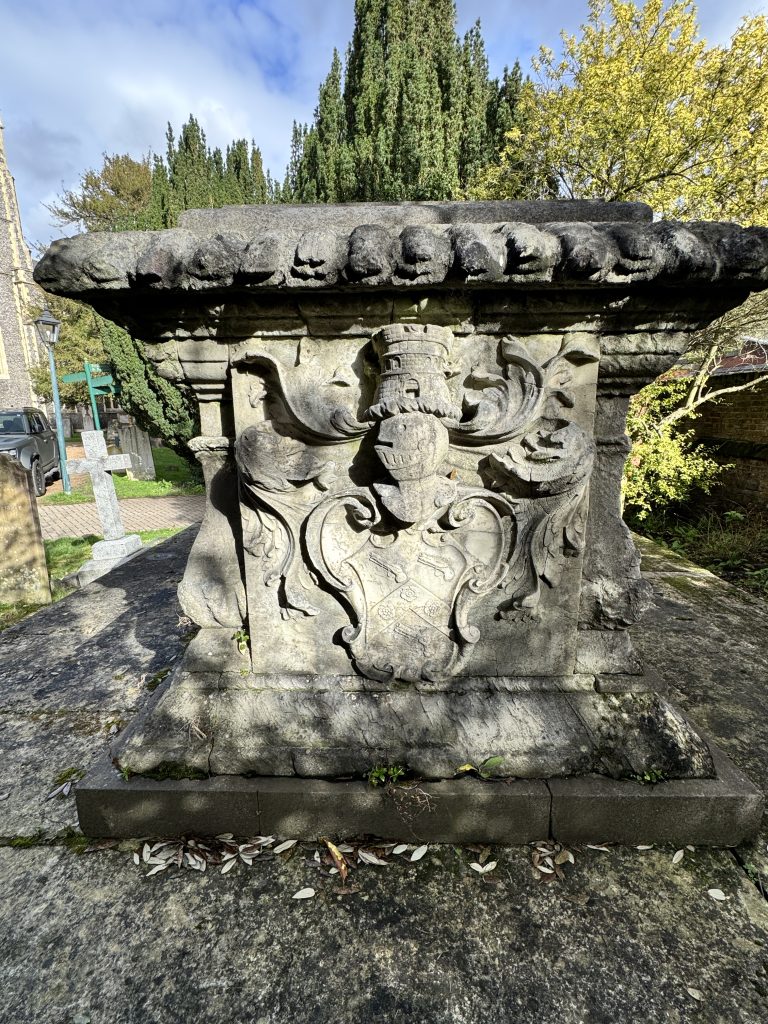
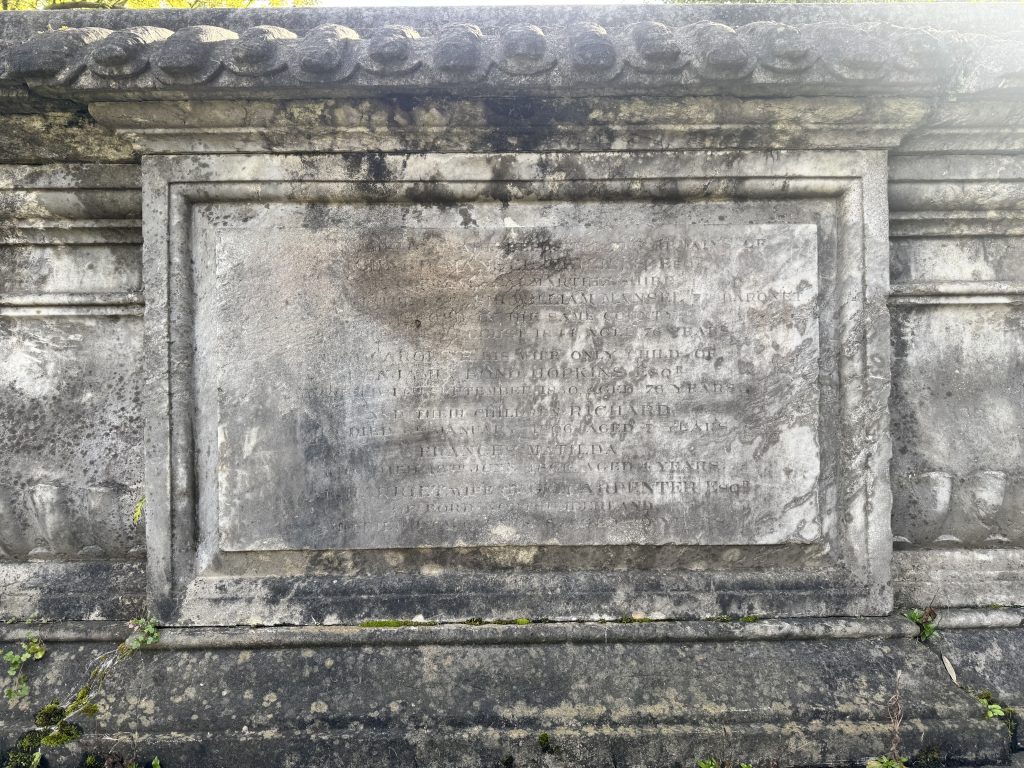
The chest tomb of Richard Mansell Philips of Coedgair and his wife Caroline  (only daughter of Benjamin Bond Hopkins) was easy to find. The monument was in good condition although the coat of arms and dedication were very worn and difficult to read.

church of St Marys Wimbledon

The church was beautiful too and we were happy to find it was open so we could look around.

A trip to the London Archives

A few weeks ago I made my first trip to the London Archives in Clerkenwell. I used to visit the Family Records Centre but that closed a long time ago (back in 2008!).

I pre-booked the research material I wanted to access and signed up for a free History card. I also paid for a photography permit so I could photograph some of the material I wanted to look at.

Included in my list were bookplates, Fire Insurance records, and the proceedings brought by Lady Mansel against her husband Sir William Mansel in 1828.

I think this may have been my first visit to an archives for family research! You were only able to take one item at a time so I tried to prioritise what I really wanted to see. However I started with the draft bond  of City of London to pay an annuity to Benjamin Hopkins, before tackling the legal proceedings brought by Lady Mansel, and the huge registers of Fire Insurance records.

I transcribed the draft bond but have to admit it wasn’t a very exciting document. So I was more excited to receive the bundle of legal proceedings. I’d love to know if anyone has looked at them since they were first tied together?!

The bundle included a cover slip, decree, citation, depositions of 12 witnesses and the cause. The records were in an amazing state so I was able to read everything and obtain a lot of information about the cause of the separation, namely that Sir William had left his wife, committed adultery by living with a couple of other women who were passed off as Lady Mansel, and had three illegitimate children. The documents provided so much detail I had never come across before, including the names and dates of the three illegitimate children.

There was so much information to read that I ended up photographing some of the papers to read at a later date.  This left me some time to look through the Fire Insurance records. Fortunately some of my Mansel ancestors had insured their London properties, which was fascinating to get a glimpse of.

I will need to make a further trip to the London Archives to see the 9 remaining Fire Insurance record entries on my list. some of these volumes are popular and had already been booked out when I requested them.

 

A newspaper clue

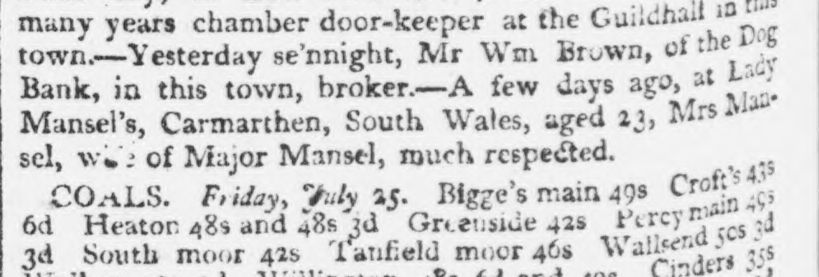
Whilst I had free access to the newspaper site I came across three entries relating to the death of Mrs Mansel, wife of Major Mansel in 1806. It took me a while to identify this lady:

I found she was the first wife of  Col John Mansel, younger brother of Sir William Mansel.

So far I only know that her first name was Mary and she died in 1806 in Carmarthenshire, Wales. Hopefully I will be able to discover more about her.

Unique new family history podcast launches

A brand-new original podcast, A Family History Of… just launched on Spotify and Apple Podcasts, exploring defining moments of British and Irish history through the eyes of real families who experienced them.

Each four‑part series follows one real person’s life through a major historical event, using original records, historical newspapers, and contextual sources to uncover how ordinary people experienced extraordinary times. It focuses on the stories not told in history books, blending gripping storytelling, archival research and intimate personal reflection, showing how individual lives illuminate the wider history of Britain and Ireland.

Regular host Jen Baldwin — genealogist and research specialist at UK family history platform, Findmypast — is joined each month by a special guest whose family history or area of expertise connects to the story being told.

The series weaves in Census records, birth, marriage and death records, crime, school, military records, historical newspapers and more, all available on Findmypast, to showcase how genealogical detective work can be pieced together to create a compelling life story.

A Family History Of Wartime Women

The debut series A Family History Of Wartime Women, features historian Lucy Worsley, who revisits the life of her grandmother, Edna, uncovering a woman shaped by two World Wars, seismic social change, and long‑buried family secrets.

The series opens in industrial Birmingham, where Edna is born just days after the 1911 Census records a nation on the cusp of transformation. Listeners are drawn into the smoky streets and tight communities that define her early childhood as Britain entered the First World War. Rationing, civic duty, and upheaval are the forces that shape her formative years.

As the 1930s unfold, Edna steps into adulthood as a boot shop assistant, navigating new freedoms and lingering societal pressures. Against the backdrop of the Blitz during the Second World War — aged 30 and pregnant — she marries Lucy’s grandfather. But wartime Britain is full of hidden complexities, and Lucy reveals a shocking family discovery about the marriage which she believes her grandmother never knew.

The next series, launching in April, will explore the Irish Famine through the eyes of the MacKenzie family, with special guest Trinity Dublin historian and founding member of EPIC The Irish Emigration Museum, Fiona Fitzsimons. Further episodes will follow lives through the 1926 General Strike and The American Revolutionary War.

Listeners can discover more about the research behind the stories and explore fascinating historical records and newspapers discussed in the episodes on the podcast website, as well as in special bonus episodes.

The podcast is the newest offering from longstanding media company DC Thomson Media, whose portfolio includes hit true crime podcasts Was Justice Served? and Who Killed Annalise? as well as top golf podcast Bunkered.

The first series of the podcast, A Family History Of Wartime Women, is available to listen on all major steaming platforms from Tuesday 3 March 2026.

Poole 1841

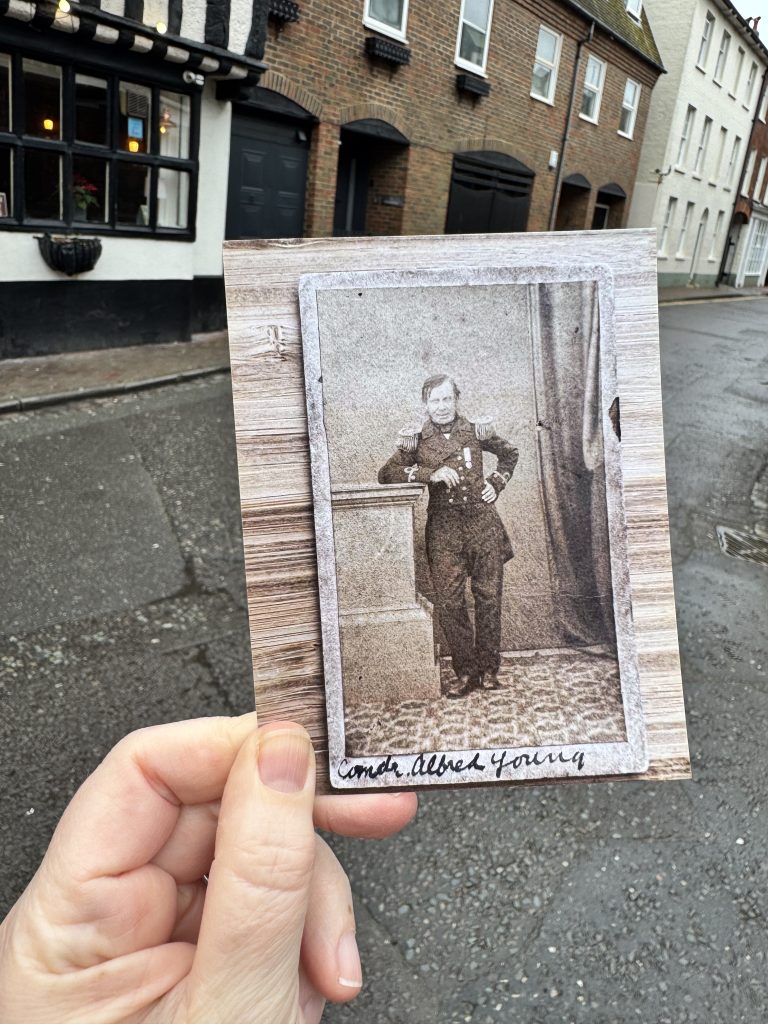
Over the weekend we visited the pretty coastal town of Poole in Dorset. On the night of the 1841 census my second great-grandfather was recorded as staying at the house of Edward Dugdale, a victualler, on the High Street. Alfred Young was 27 and his occupation was listed as Navy.

I have one photograph of him in his naval uniform, so I thought it would be fun to take it with me and try and find the location on the census. There are some beautiful old buildings around this end of the high street but unfortunately I couldn’t locate a specific building.

A triple wedding {July 27th 1813}

I have been making full use of free access to newspaper records which I told you about on Monday.

I’ve found some great newspaper clippings which have added another dimension to my family history research. I already knew about the marriage between William Mansel (son of William Mansel the 10th Baronet) and Harriet Oliver in 1813. I discovered that they were married along with two of her sisters on the same day at Brill in Buckinghamshire! How romantic.