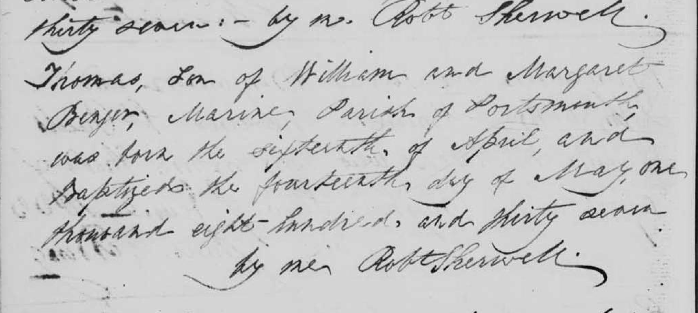
I have a keen interest in Portsmouth records as I have several family members who lived in the area. I was pleased to read that earlier this month Findmypast published over 2.4 million new records in partnership with the Portsmouth History Centre.
Access to over 2 Million Portsmouth Records
Fully searchable transcripts of each original document are also included, enabling anyone to go online and search for their Portsmouth ancestors by name, location and date.
Hampshire, Portsmouth, Portsea Island Rate Books
Search through over a million pages of poor rate books from as early as 1700 through to 1921. The books recorded the amount of rates paid at each property, ownership of the property, and its location in the parishes of Portsea and Portsmouth. Discover the history of your ancestral home, today. With each record you will find a transcript of the vital facts and an image of the original rate poor.
Poor rate books were records of the amount of rates paid and by whom. Rates were levied annually and collected from both property owners and occupiers. The money was used for local poor relief. The Poor Law Act of 1598 made the parish responsible for the poor. The original records are held at the Portsmouth History Centre.
Hampshire, Portsmouth Hospital Records
Search for your ancestors in this fascinating collection of assorted hospital records and medical journals from St James Hospital between 1878 and 1918. At that time, the hospital was known as the Portsmouth Lunatic Asylum. Each result will give you a transcript of the vital facts and an image of the original hospital document. Images may provide you with even more information about your ancestor’s life, condition and treatment.
The Portsmouth Hospital Records have been digitised by Findmypast from the collection held by the Portsmouth History Centre. The collection includes a range of documents from the years St James Hospital operated as the city’s lunatic asylum including civil registers, deaths, indexes to admissions and discharges, maintenance ledgers, patient notes, registers of discharge and transfers.
Patient notes recorded the individual’s progress from their condition when they first entered the hospital and how or if the person improved. You will find notes such as, ‘delusions of grandeur’, ‘excited’, ‘clean’, or one patient was recorded as claiming she was the ‘Queen of Brighton’.
Hampshire, Portsmouth Police Staff Records, 1908-1924
Discover your English police heritage in this collection of police records from Portsmouth. The collection has been digitised by Findmypast from the records held at the Portsmouth History Centre. The Portsmouth Police Service was formed in January 1836. The city had its own police force from 1836 until 1967. The city’s fire brigade was also a branch of the police force when it was first formed.
With every results you will find an image of the original document and a transcript of the vital facts. The transcripts may include a combination of the officer’s age, birth year and birth place as well as their trade or calling, years of service and dates of appointment and discharge. Images may contain a variety of additional details including physical descriptions, photographic portraits, service histories and reasons for discharge/retirement.
Hampshire, Portsmouth Quarter Sessions Browse
Explore thousands of criminal records from these court Quarter Sessions, discover if your Portsmouth ancestors had been caught up in a criminal activity. Findmypast’s browse search allows you to search each Session register from beginning to end. As well as the accused’s age, aliases and home parish, the records will provide you with a wide variety of details relating to their offence, trail and sentencing.
The courts of quarter sessions were held over a number of days in rotation at different locations at four set times each year. They dealt with serious non-capital crimes, and formed the middle tier of the court system. Quarter sessions were presided over by unpaid magistrates, also known as justices of the peace, appointed by the Lord Chancellor. At each session, two juries would be elected. The Grand Jury’s job was to hear the evidence against the accused and to decide whether the case should go to trial. If they sent it forward it was the turn of the Trial or Petty Jury who would decide guilt.
Hampshire, Portsmouth Burials
Was your ancestor buried in Portsmouth, Hampshire? Discover your ancestor’s burial entry in over 129,000 additional Portsmouth parish records to uncover the location of their final resting place. The new additions cover Portsea, Highland Road and Kingston cemeteries between the years 1831 and 1902.
Results will provide you with transcripts and images of the original register entry. Transcripts will reveal a combination of the deceased’s birth year, death year, age at death, burial date, burial location, denomination, occupation, residence and relatives names. Image may provide additional details such as the name of the minister who performed the ceremony.
England & Wales, Electoral Registers 1832-1932
Over 64,000 additional images covering the Parliamentary Borough of Portsmouth have been added to the collection. You can search the records by personal name, polling district, county and constituency, as well as by keyword search to discover the history of your family home in the nineteenth and twentieth century.
Electoral Registers are lists created annually of people who are eligible to vote and include their reason for eligibility, such as their residence or ownership of a property. Until 1918, the right to vote was closely linked to property ownership. The details in the registers may vary slightly, but in most you will find a combination of your ancestor’s address, qualification to vote and occasionally a description of the residence, their occupation and age.
Hampshire, Portsmouth Trade Directories 1863-1927
Explore more than 30,000 pages of Portsmouth trade directories. Trade directories are an excellent resource for anyone researching their family history and want to understand more about their ancestor’s life. They provide insights into local business owners, trades people, civil servants, church leaders, school teachers and much more.
Each record includes an original image of the trade directory that will list your ancestor’s company name, occupation and address.
I haven’t had time to use any of the new records yet, really hoping for some time over New Year!