Author Archives: jenny

Little black book

Kathleen Hacker and Robert Winchcombe were my maternal grandparents. My grandmother was one of ten children and there was nothing I liked more than sitting with her and looking through her black and white photographs and listening to her stories. One of my favourites was how she met my grandfather and how Hitler tried to upstage their wedding.

In 1936 Robert Winchcombe was unemployed after his apprenticeship had come to an end at the Great Western Railway Works in Swindon. He earned some money playing clarinet and 1st or 2nd Alto Saxophone in local dance bands, including the Harry Smith Band, the Moderniques, St. John’s Dance Band, and the New Georgians, who played all over Wiltshire and Berkshire.

Around this time he met my grandmother at the St Barnabas Church Badminton Club. He was an altar server at St Barnabas, sang in the choir and was also a member of the Youth Group.

After his death I inherited a small black engagement book for 1937-38 where he had meticulously recorded all his musical engagements as well as dates with his future wife.

Their first official date occurred on the 17th of December 1937 where Robert has written ‘1st engagement with K.H.‘ It must have gone well as there’s a small ‘K‘ pencilled in on Christmas Day, as well as ‘Went to tea at K’s brothers‘ the day after. They see each other several times each week, play badminton together, attend concerts, go on church outings and visit relatives.

In March Robert was given a couple of weeks work back in the Great Western Railway before they gave him 2 weeks notice during the middle of May. His engagement book then records a succession of interviews – ‘24th May Gloucester for work unsuccessfully‘, ‘28th June South Cerney unsuccessful application for work‘ and ‘21st July Colbournes unsuccessfully, Baines’ ditto‘.

The engagement book ends on the 4th of September 1938. Fortunately I’m able to fill in the gaps which give the story a happy ending. Robert Winchcombe eventually got a job at the Gloster Aircraft Factory in Gloucester, presumably soon after September 1938, and he and Kathleen Hacker were able to get engaged. They were married four days after war was declared, their wedding plans hurriedly changed as the church hall was requisitioned, and started married life in Churchdown, Gloucester.

[This was an exercise for my Creative Writing course which I hope will be of interest]


Fancy dress in Swindon

Description

Black and white photograph of a group of children in fancy dress.

Caption for picture

My grandmother made all my mother and aunt’s clothes and I have many photographs showing them in knitted swimsuits, Sunday best and fancy dress. My mother, third from right, is dressed as Little Bo Peep. My aunt, second from right, wears a wedding dress. Taken around 1945 in Swindon.

Comments:

I have so many photographs of my mother and aunt in similar situations. They really make me smile as I’m currently experiencing the same kind of events  with my own young children. Writing about this image has made me feel guilty I don’t know more about the circumstances, so I’ll be asking my mother about it today!

Edited – “it was taken at the St Mary’s Church, Rodbourne Cheney, Swindon, summer fair, in the Vicarage garden. It was taken with a Box Brownie, and I think it would have been in about 1948, the year we went to live in Rodbourne Cheney. I wore my Little Bo-Peep costume that I’d previously worn for the Victory street party at the end of WWII, but I’d grown  a bit, so Nanny put a frill on the bottom to make it long enough. Pauline was a bride, but neither of us won the prize. I was 7, Pauline was 3.

Nanny made both our costumes, as she did for almost everything we wore, and fancy dress costumes were constantly recycled to make different ones for cousins, etc. She was a whizz with sewing and knitting, and because materials etc were on ration, adult clothes were unpicked to make clothes for children. Jumpers and cardigans were unpicked, the wool skeined and washed, and used again. Only people who were handy with a needle could do this, and mum’s skills were used by all her family.”

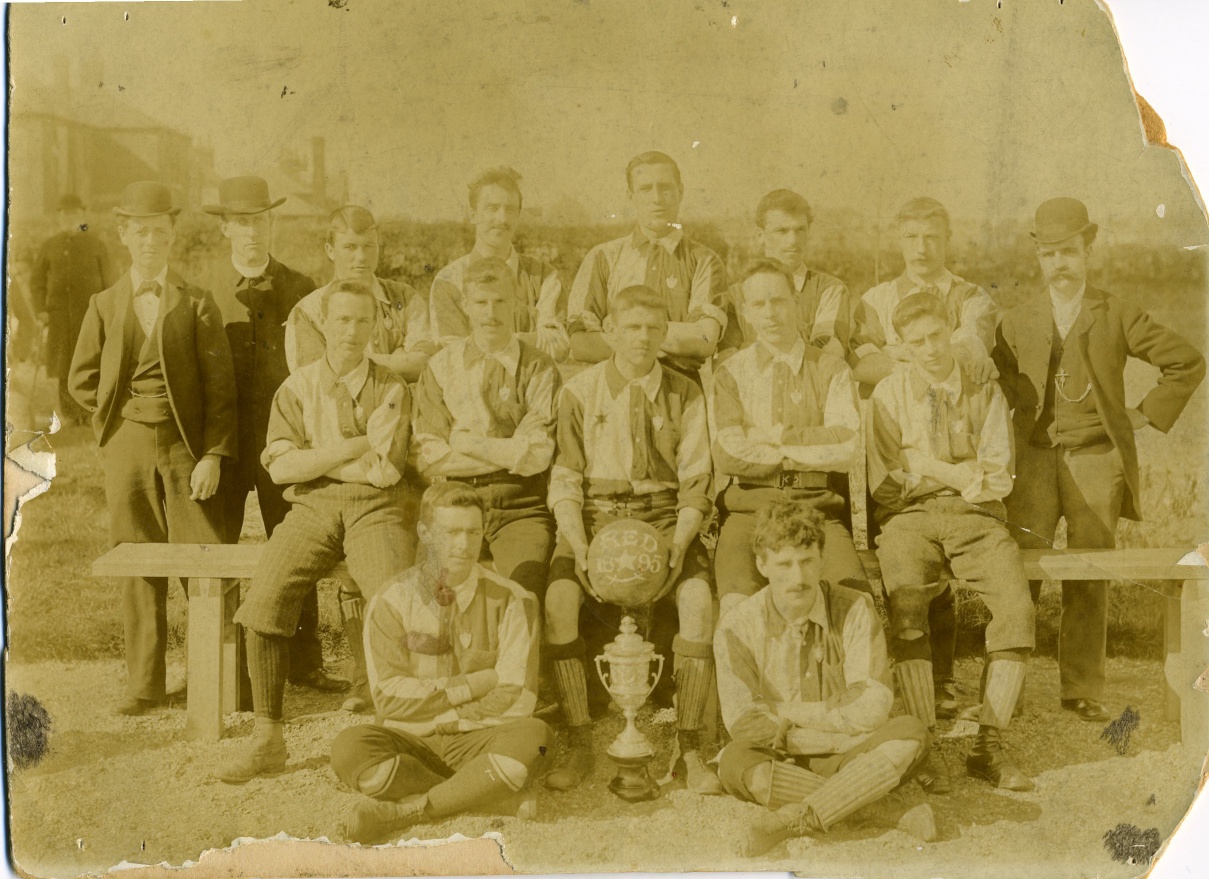
George Benger (photograph)

Description Black and white group photograph showing a football team, one man holds a football which features the words RED 1895, beneath which is a silver cup.

Caption for picture My great-grandfather, George Benger (1876-1951) appears in the centre of the back row of this football team photograph.  In 1895 he was part of the winning team and won a silver shield in the Senior Cup which is now in my possession. The shield he was given is engraved with ‘Portsmouth Football Association’, his name, and the letters GRS. His occupation was a Plumber, he later worked for the Naval Ordnance, and was awarded the Imperial Service Medal for ‘Particular Meritorious Service’ in 1936.

Comments

I chose this photograph as it illustrates a different side to this relative, rather than the usual birth, marriage, death or occupation facts I have usually uncovered.


Admiral Mansel (photograph)

My creative writing course is going really well although I am struggling to fit in the work around normal life. One of our latest exercises has been writing captions for photographs. I thought this would make great posts as I love sharing my family photographs.

Description 

Black and white portrait card of Admiral Mansel seated at a chair holding a walking stick in his right hand and papers in his left. He wears a suit, is white haired with a beard and ancient. The card is signed in ink.

Caption for picture

Black and white portrait card of Admiral Mansel in old age. Thomas Mansel (1783-1869) was the 7th of 11 children of Sir William Mansel, Baronet. He entered the Navy in 1798, he served under Lord Nelson at the battle of Copenhagen, and travelled to every quarter of the globe.

Comments

I adore this photograph as I have many of this type but all un-named except this one and one of his son. I like to think he was a very grand man as this photograph is so serious but I’ll never know!


Distance learning

My distance learning course started this week. So far I’ve accessed the online learning environment to find out more about the other participants and start the first session. I’m hoping it’s alright to write about it on my personal blog as well as through the Exeter Learning Environment.

We’re looking at three aspects of writing memoir and family history. These are:

  • Your ancestry: the history of your family before you were born
  • Your family story: the relatives and family who you’ve known during your lifetime
  • Your personal history: your life as an individual, but with special relevance to your place in the family story and your ancestry

I’m hoping to focus on the first one as this most interests me.

After beginning to read the course notes I discovered the course reading list. I had a quick google and loved the sound of most of the books so I admit I’ve ordered a few. Even if I don’t get round to reading them during the course, I know I will still enjoy them. Hopefully I can review them here too.

My first challenge is to write a a brief ‘pen portrait’ of someone from my family, the person should be significant and I should have met them. I have to write it in less than 250 words. Wish me luck!

Cousin catcher

I recently heard a phrase which suggested that family history blogs are cousin catchers! I have to agree. I don’t update this poor blog very often but the information is ‘out there’ and I recently received an exciting email from someone who I was very distantly related to.

Jane Bate very kindly filled me in on what happened to the Duncan family where my information left off at the 1911 census.

It was really strange reading about who they married and the children they had, but fascinating to fill in some gaps. Time to update my GEDCOM file and learn how to upload the latest version here I think!