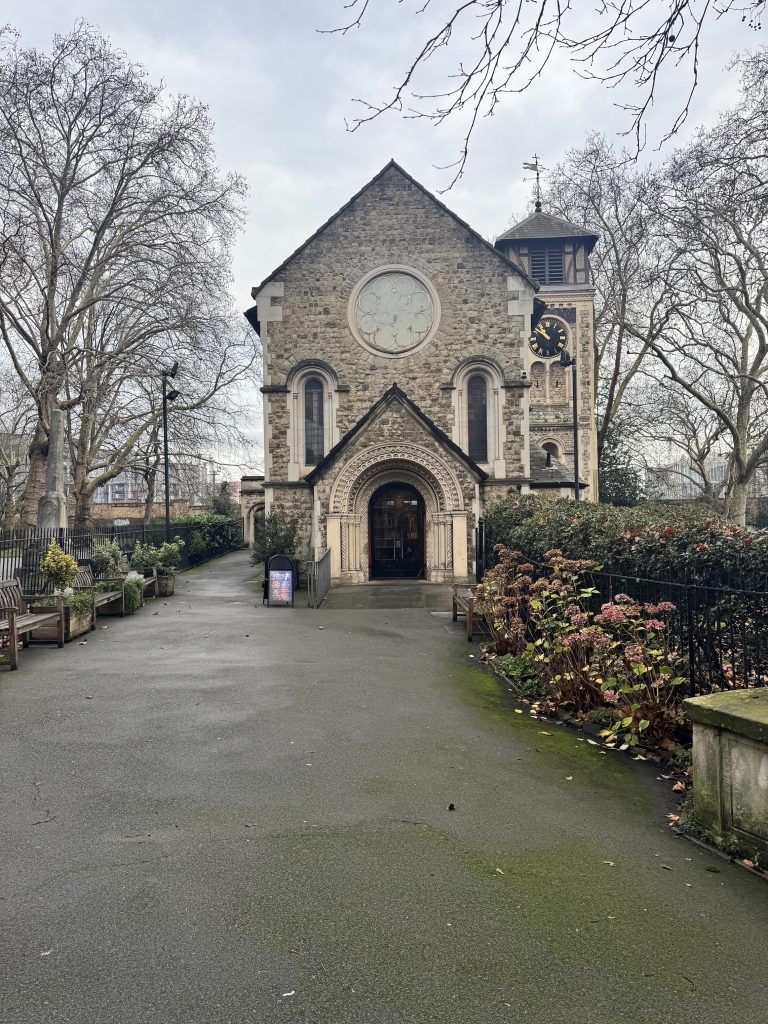
St Mary’s Church Wimbledon

This year I am adding St Mary’s Church Wimbledon to my list of places to visit. The churchyard is the burial place of William Mansell Philips of Coedgair (my third great-granduncle), his father-in-law Benjamin Bond Hopkins, and his benefactor John Hopkins, aka Vulture Hopkins.

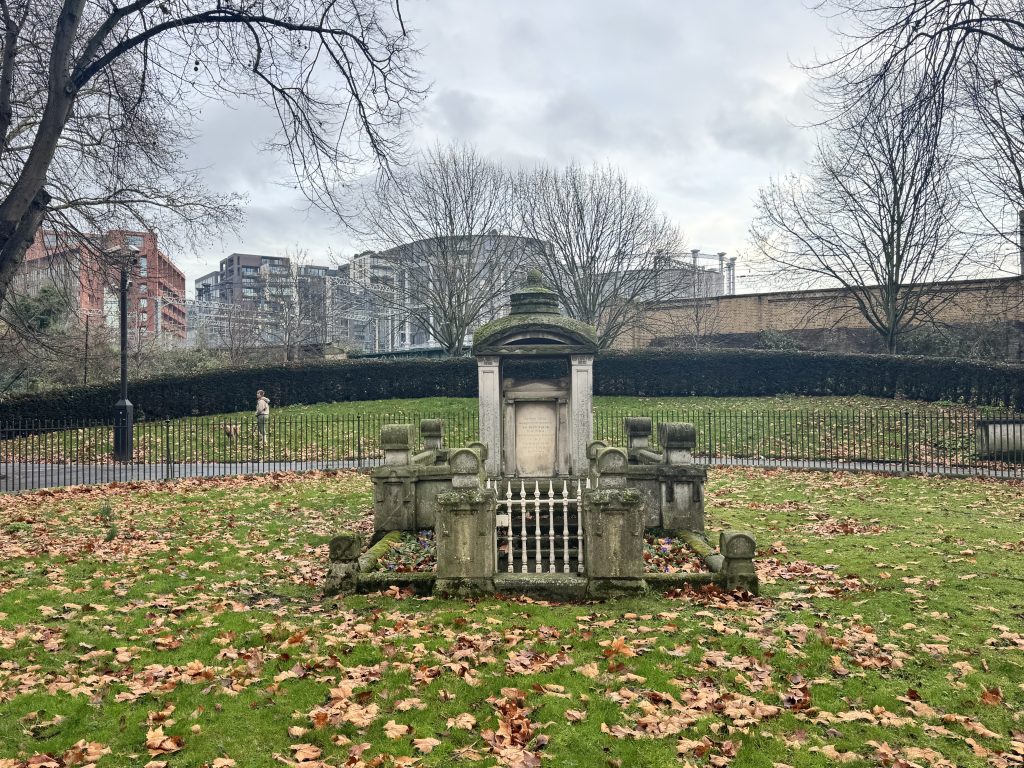
Tomb of John Hopkins, aka Vulture Hopkins

Died 1732. Mentioned by Alexander Pope and Charles Dickens in Our Mutual Friend. His money was made speculating in the South Sea Bubble and left £300 000 when he died.

His heir was Benjamin Bond although he could not inherit for 40 years (as stipulated in the Will), he inherited in 1772. He added the name Hopkins, bought Painshill which we have previously visited, became an MP, and married 3 times.

Tomb of Benjamin Bond Hopkins (this does not survive)

According to the antiquarian Daniel Lyson’s “At the entrance if the church-yard, on the right hand, is a large columbarium made by Benjamin Bond Hopkins, Esq. for the internment of his family. Within it are inscriptions upon tablets of white marble to the memory of Benjamin Bond Hopkins, Esq. of Clapham, who died in 1783; his wife Elizabeth, who died in1787; and Eliza and Alicia, wives of Benjamin Bond Hopkins, Esq. of Painshill, who died in 1771 and 1788.”

Tomb of Richard Mansell Philips of Coedgair – buried Caroline (his wife and only daughter of Benjamin Bond Hopkins). Tomb does survive and is a chest tomb with coat of arms.

Gentleman’s Magazine commented in 1794 “we doubt whether Mr Bond Hopkins’s oldest daughter was not by his first wife. Be that as it may he has left to his surviving and now only daughter £50,000 when she attains the age of 24 over and besides 800l per annum of her mother’s jointure.

They married in 1797 and had four children: Richard, Courtenay (army?), Frances and Edward. Richard too the additional name of Phillips on 24/01/1793. They lived at Wimbledon Common, probably Southside Common (along the southern side of the Common from No. 1 to No. 12 which form a narrow strip of development. The original mansions were described as an assemblage of gentleman’s houses, most delightfully situated with good gardens from whence is a pleasant prospect over the luxuriant vale beneath. Originally built by John Hopkins who purchased the land in the 1720s. The estate was inherited by Benjamin Bond and then to his daughter Caroline Philips, whose children and grandchildren gradually sold off the land to developers after she died in 1850. From the late 1850s they were knocked down and re-developed.

No. 2 and 3 Southside were built on the site of The Grange and was built in 1747 by Thomas Lewis and included a house, garden, pleasure grounds and a meadow which reached as far as the Ridgeway. The present house on the site dates from 1889.

The house was occupied by Mrs Caroline Philips (1835-1841) and later Sir Richard Mansel (1882-1885) amongst others. [info from Sub Area 7: Southside Common on merton.gov.uk website]
John Bell of Harefield

Elizabeth Dowager Lady Mansel was the daughter of John Bell, a distant relation. I have not managed to discover much about him so far. I know he lived in Harefield, Middlesex, which is a strange coincidence as we live in neighbouring Ruislip. This made me want to learn more about the family.

John Bell of Harefield

Harefield is a small village so I was intrigued as to where the Bells may have lived in Harefield.

I have been trying to find a copy of his Will. His daughter married William Mansel, 10th Baronet, so they must have had money and connections, therefore some evidence should have survived.

I found one result on the National Archives website, which took me back to The London Archives:

reference CLC/B/192/F/001/MS11936/351/539052

Collection: Royal and Sun Alliance Insurance Group

Created 3 Jan 1788

Insured – John Bell, Harefield Common, Harefield, Middlesex, Esq.

Unfortunately the item is a physical document which hasn’t been digitised. I’m not sure how much information will be in the record, so unsure if it worth making an appointment to view it.

Strangely, I found other relatives mentioned in this group of records recently. Presumably this means they owned property and wanted to insure their property and the contents in case of loss through fire?

According to The London Archives, fire insurance policy registers generally give the following information:

  • policy number
  • date of policy
  • name, occupation and address of policy holder
  • brief description of the property being insured
  • premium paid

So hopefully I can find out more about John Bell at some point, it sounds like it could be worth a visit.

Lady Elizabeth Mansel

Elizabeth Dowager Lady Mansel

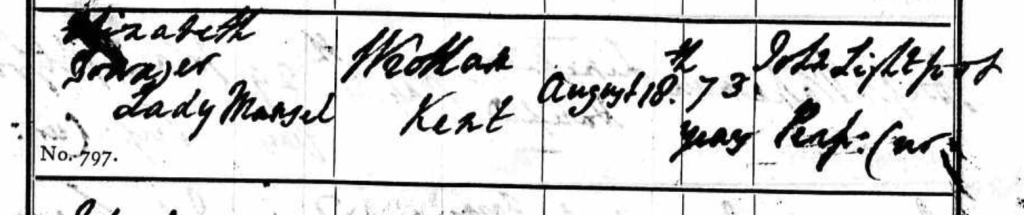
Lady Mansel was buried at Saint Mary the Virgin, Harefield on 18th August 1843, her main residence was Wrotham in Kent.

Death Notice was published in The Essex County Standard, etc., Friday, August 18, 1843, Page 3:

Daughter of Mr. and Mrs. John Bell. Married Sir William Mansel, 10th Mansel Baronet of Muddlescombe, in 1791 at Harefield, England. They had two sons. William and Sir John Bell Mansel, 11th Baronet.

According to Find a Grave she died on the 12th August and was buried at Wrotham Cemetery. Perhaps her death was recorded on a memorial at Wrotham Cemetery, but there is clearly an entry of her burial at Harefield, so there is some confusion over this.

Mansel records at The London Archives

Records relating to the Mansel family held at The London Archives – to be ordered in advance of visit:

Insured: Caroline Phillips, 22 Seymour Street, Portman Square, wife of Richard Mansel Phillips
Created Jan 12 1810
Reference code CLC/B/192/F/001/MS11936/453/839743
From Collection: Royal and Sun Alliance Insurance Group

Insured: Lady Elizabeth Mansel 21 Seymour Street, Portman Square
Created Sep 30 1831
Reference code CLC/B/192/F/001/MS11936/533/1128728
From Collection: Royal and Sun Alliance Insurance Group

Insured: Lady Elizabeth Mansel 21 Seymour Street, Portman Square
Created Feb 1 1833
Reference code CLC/B/192/F/001/MS11936/538/1150330
From Collection: Royal and Sun Alliance Insurance Group

Insured: Lady Elizabeth Mansel 21 Seymour Street, Portman Square
Created Mar 18 1835
Reference code CLC/B/192/F/001/MS11936/545/1194918
From Collection: Royal and Sun Alliance Insurance Group

Insured: Lady Elizabeth Mansel of Wrotham Heath, Kent
Created Jan 3 1838
Reference code CLC/B/192/F/001/MS11936/564/1263550
From Collection: Royal and Sun Alliance Insurance Group

Daring Burglary at a Rectory from Liverpool Daily Post (Chubb safe belonging to the Reverend T. Mansel Playdell carried away from Bergen Rectory, near Hertford, Hertfordshire)
Created May 25 1888
Reference Code:CLC/B/002/10/01/041/057B
From Collection: Chubb & Son Limited

Bookplate collection: Iscoed Quod Vult Valde Vult
Reference code: SC/GL/BPL/01/M/002/006/001

Matrimonial cause: Mansel, Dame and Baronet
1827-1828
Reference code: DL/C/0944
Collection: Diocese of London
Bundle includes: cover slip, decree, citation, decree to see proceedings, proxy of Lady Mansel, court act to lead decree to see proceedings, document concerning production of witnesses, act to lead compulsory, compulsory, court act to lead compulsory, bond, libel with one exhibit, depositions of 12 witnesses. Cause; divorce or separation by reason of adultery


St Pancras Gardens

Last week I dragged my son for a walk around St Pancras Gardens. These gardens are the burial ground attached to St Pancras Old Church. The burial ground contains some architecturally significant tombs, including that of Sir John Soane (one of only two Grade I listed monuments in London).

Sir John Soane tomb

The Hardy Tree

This was a famous landmark in the gardens. Thomas Hardy (the author) had worked on relocating the grave stones around Old St Pancras when the Midland Railway line was being built as part of the development of St Pancras station in the 1860s. Unfortunately the tree fell down in 2022.

the Hardy Tree

I know that my relative Sir William Mansel, 10th Baronet, was buried in the churchyard in 1829.

Death Notice in the Cambridge Chronicle and University Journal, Isle of Ely Herald and Huntingdonshire Gazette, Friday, September 4, 1829, Page 2.

His body was probably moved elsewhere when the cemetery closed in 1854.

A little catch up

It’s been a long time since I last wrote a post here. I haven’t been doing much family research, I think achieving the goal I set myself earlier this year threw me a little. Although there was a second goal I didn’t really feel like starting it and even looked into cancelling my Ancestry subscription – yep, still haven’t done that.

However, Find My Past had free access to some of their records over Remembrance Day, so I took the opportunity to look up any military records. I found quite a few records I hadn’t seen before, for Matthew Young, Bennett Cutherbertson and John Mansel, C.B. These are all safely saved for now.