Bankruptcy in The London Gazette

I was intrigued by a discovery that on 8th March 1828 the Cambrian reported the case of Lady Eliza Mansel against her husband on the grounds of his adultery.

I haven’t been able to find any more information about this at the moment. However, I tried searching The London Gazette for any mention and  came across this in 1825:

The Commissioners in a Commission of Bankrup- awarded and issued forth against William Mansel, formerly of Grove-Lane, Camberwell, in the County of Surrey, afterwards of Downing-Street, in the City of Westminster otherwise Sir William Mansel, Baronet (now confined in the King’s-Bench Prison), Picture-Dealer and Chapman, intend to meet on the 26th day of July instant, at Ten of the Clock in the Forendon, at the Court of Commissioners of Bankrupts, in Basinghall-Street, in the City of London, in order to receive the Proof of Debts under the said Commission.

In 1827 also in The London Gazette

Pursuant to the Act for the Relief of Insolvent Debtors in England.

The Court for Relief of Insolvent Debtors:

The matters of the petitions and schedules of the prisoners hereinafter named (the same having been filed in the Court) are appointed to be heard at the Court-House, in Portugal-Street, Lincoln’s-Inn-Fields, on Tuesday the 30th day of October 1827, at Nine o’Clock in the Forenoon.

Sir William Mansell, Bat. formerly of Park-Place, Regent’s-Park, Middlesex, then of Leamington, Warwickshire, next of Shrewsbury, Shropshire, and late of Dover, Kent.

Unfortunately I have not been able to discover the outcome of the petition but it was interesting that he may have spent two years in prison for being a debtor. Definitely adding this to my list of loose ends to research further. It also suggests other places of residence that I did not know about.

Researching at The London Archives

At some point this year I’m hoping to make a visit to The London Archives. As I try to look outside of Ancestry for historical records I discovered that other archives have records which would add to my understanding of my family.

So far I’ve located the following records of interest:

Draft bond of City of London to pay an annuity of £4.10.0 to Benjamin Hopkins. Dated 1778/Middlesex Sessions of the Peace/County Administration. Reference MA/S/275

Insured Jane Thompson, London Wall, callenderer in trust, and Caroline Bond Hopkins, spinster. Dated Nov 19 1791/Royal and Sun Alliance Insurance Group.
Reference CLC/B/192/F/001/MS11936/381/592506

Insured Benjamin Bond Hopkins, Paines Hill near Cobham, Surrey, esq.
Date Nov 26 1794/ Royal and Sun Alliance Insurance Group
Reference CLC/B/192/F/001/MS11936/400/634801

Insured Benjamin Bond Hopkins Esq.
Date Jan 3 1814/ Royal and Sun Alliance Insurance Group
Reference CLC/B/192/F/001/MS11936/462/889397

Insured xx executor Benjamin Bond Hopkins deceased
Feb 26 1838/ Royal and Sun Alliance Insurance Group
Reference CLC/B/192/F/001/MS11936/563/1269625

Insured xx in trust for Caroline Bond Hopkins, Grosvenor Square, Spinster
Date Feb 13 1790/ Royal and Sun Alliance Insurance Group
Reference CLC/B/192/F/001/MS11936/366/566242

Insured xx Benjamin Bond Hopkins
Date Aug 28 1790/Royal and Sun Alliance Insurance Group
Reference CLC/B/192/F/001/MS11936/370/573126

I’ve never visited The London Archives before (what was The London Metropolitan Archives) and am excited to do proper research away from a computer screen.

St Mary’s Church Wimbledon

This year I am adding St Mary’s Church Wimbledon to my list of places to visit. The churchyard is the burial place of William Mansell Philips of Coedgair (my third great-granduncle), his father-in-law Benjamin Bond Hopkins, and his benefactor John Hopkins, aka Vulture Hopkins.

Tomb of John Hopkins, aka Vulture Hopkins

Died 1732. Mentioned by Alexander Pope and Charles Dickens in Our Mutual Friend. His money was made speculating in the South Sea Bubble and left £300 000 when he died.

His heir was Benjamin Bond although he could not inherit for 40 years (as stipulated in the Will), he inherited in 1772. He added the name Hopkins, bought Painshill which we have previously visited, became an MP, and married 3 times.

Tomb of Benjamin Bond Hopkins (this does not survive)

According to the antiquarian Daniel Lyson’s “At the entrance if the church-yard, on the right hand, is a large columbarium made by Benjamin Bond Hopkins, Esq. for the internment of his family. Within it are inscriptions upon tablets of white marble to the memory of Benjamin Bond Hopkins, Esq. of Clapham, who died in 1783; his wife Elizabeth, who died in1787; and Eliza and Alicia, wives of Benjamin Bond Hopkins, Esq. of Painshill, who died in 1771 and 1788.”

Tomb of Richard Mansell Philips of Coedgair – buried Caroline (his wife and only daughter of Benjamin Bond Hopkins). Tomb does survive and is a chest tomb with coat of arms.

Gentleman’s Magazine commented in 1794 “we doubt whether Mr Bond Hopkins’s oldest daughter was not by his first wife. Be that as it may he has left to his surviving and now only daughter £50,000 when she attains the age of 24 over and besides 800l per annum of her mother’s jointure.

They married in 1797 and had four children: Richard, Courtenay (army?), Frances and Edward. Richard too the additional name of Phillips on 24/01/1793. They lived at Wimbledon Common, probably Southside Common (along the southern side of the Common from No. 1 to No. 12 which form a narrow strip of development. The original mansions were described as an assemblage of gentleman’s houses, most delightfully situated with good gardens from whence is a pleasant prospect over the luxuriant vale beneath. Originally built by John Hopkins who purchased the land in the 1720s. The estate was inherited by Benjamin Bond and then to his daughter Caroline Philips, whose children and grandchildren gradually sold off the land to developers after she died in 1850. From the late 1850s they were knocked down and re-developed.

No. 2 and 3 Southside were built on the site of The Grange and was built in 1747 by Thomas Lewis and included a house, garden, pleasure grounds and a meadow which reached as far as the Ridgeway. The present house on the site dates from 1889.

The house was occupied by Mrs Caroline Philips (1835-1841) and later Sir Richard Mansel (1882-1885) amongst others. [info from Sub Area 7: Southside Common on merton.gov.uk website]

John Bell of Harefield

Elizabeth Dowager Lady Mansel was the daughter of John Bell, a distant relation. I have not managed to discover much about him so far. I know he lived in Harefield, Middlesex, which is a strange coincidence as we live in neighbouring Ruislip. This made me want to learn more about the family.

John Bell of Harefield

Harefield is a small village so I was intrigued as to where the Bells may have lived in Harefield.

I have been trying to find a copy of his Will. His daughter married William Mansel, 10th Baronet, so they must have had money and connections, therefore some evidence should have survived.

I found one result on the National Archives website, which took me back to The London Archives:

reference CLC/B/192/F/001/MS11936/351/539052

Collection: Royal and Sun Alliance Insurance Group

Created 3 Jan 1788

Insured – John Bell, Harefield Common, Harefield, Middlesex, Esq.

Unfortunately the item is a physical document which hasn’t been digitised. I’m not sure how much information will be in the record, so unsure if it worth making an appointment to view it.

Strangely, I found other relatives mentioned in this group of records recently. Presumably this means they owned property and wanted to insure their property and the contents in case of loss through fire?

According to The London Archives, fire insurance policy registers generally give the following information:

  • policy number
  • date of policy
  • name, occupation and address of policy holder
  • brief description of the property being insured
  • premium paid

So hopefully I can find out more about John Bell at some point, it sounds like it could be worth a visit.

Lady Elizabeth Mansel

Elizabeth Dowager Lady Mansel

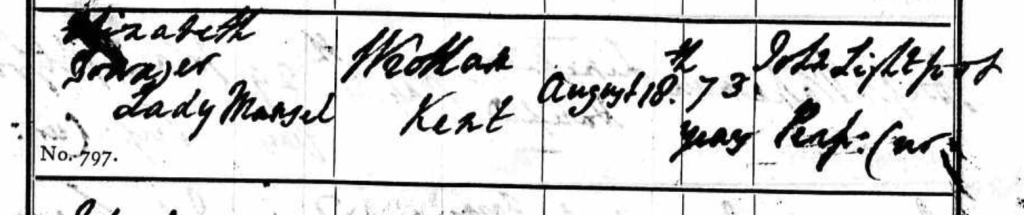
Lady Mansel was buried at Saint Mary the Virgin, Harefield on 18th August 1843, her main residence was Wrotham in Kent.

Death Notice was published in The Essex County Standard, etc., Friday, August 18, 1843, Page 3:

Daughter of Mr. and Mrs. John Bell. Married Sir William Mansel, 10th Mansel Baronet of Muddlescombe, in 1791 at Harefield, England. They had two sons. William and Sir John Bell Mansel, 11th Baronet.

According to Find a Grave she died on the 12th August and was buried at Wrotham Cemetery. Perhaps her death was recorded on a memorial at Wrotham Cemetery, but there is clearly an entry of her burial at Harefield, so there is some confusion over this.

Discover seafaring ancestors in exclusive new Royal Navy records

Family historians can now uncover the stories of their naval ancestors like never before, thanks to the latest major release of exclusive Royal Navy records – part of the landmark digitisation project by Findmypast in partnership with the National Museum of the Royal Navy.

In the first release of the year, over 121,000 exclusive new Royal Navy records are available online for the first time, opening up an extraordinary resource for genealogists worldwide. This release includes five major record sets, offering unparalleled detail about life and service at sea, with further releases planned throughout the year*.

These exclusive new collections provide unprecedented access to personal details that were previously only accessible to visitors to the Royal Navy archives in Portsmouth. Whether your ancestor served on a famous submarine, in the WRNS, or aboard a warship during WWII, these records offer a chance to uncover their story in vivid detail.

Researchers at Findmypast have already uncovered some extraordinary stories within the new records, including that of HMS Torbay, once dubbed the “most famous submarine in the world” and now all but lost in public memory. The 60-strong crew took part in some remarkable action during the Second World War, including the covert commando raid, ‘Operation Flipper’, which unsuccessfully attempted to assassinate German General Erwin Rommel. In one of the most audacious submarine actions, the Torbay also penetrated the heavily defended Axis-held harbour on the Greek island of Cephalonia, surfacing among enemy ships and firing torpedoes at point-blank range to sink and damage many of them, before enduring 17 hours of relentless pursuit and finally slipping away into the Mediterranean. The operation earned the submarine a Mention in Despatches, and her crew went on to receive one of the most remarkable clusters of awards in Royal Navy history.

The new records include:

British Royal Navy Casualty Logs, 1939-1945: Trace your family members through the fierce sea battles of the Second World War, including major moments like the loss of HMS Hood and other significant casualties. This exclusive new collection of 5,400 ships and 100,000 names. Search by name, official number, age, ship name, injury and death dates.

British Royal Navy Submarine Movement Cards: Forming the first cohesive collection of Royal Navy submarine records online, you’ll be able to search over 40,000 service cards to discover details like name, rating, official numbers, birth dates, awards, and every ship served on with dates. Uncover action below the waves from the early years of this covert service during WWI, through the major engagements of the Second World War, and into the tension of Cold War patrols.

British Women’s Royal Naval Service Enrolment Forms, 1917–1919: Delve into the experiences of the women of the Royal Navy during the First World War in over 6,000 detailed enrolment forms of the WRNS. Records include key details like name, age, address, marital status, next of kin, and personal questionnaires. They offer rich insight into women’s lives before joining the WRNS, with signatures and service contracts.

Royal Naval Division Records, 1916–1919: This unique collection contains unique cards digitised for the first time, providing details of the officers and ratings who joined or trained at the major Navy centre at Crystal Palace – officially known as HMS Victory VI – during the First World War. It contains around 4,500 names, covering birth date, address, occupation, next of kin, and service number, offering never-before seen information on those who undertook specialist technical and medical training during the war. The collection builds on Royal Naval Division Cards already available on the site thanks to the ongoing partnership with the National Archives.

British and Allied Warships Lost in WWII, 1939–1945: Discover the details of all major British and Allied warships lost under British operational control, helping to provide context and understanding of your ancestor’s Second World War experiences.

The new records form part of an ever-expanding new British Naval hub on Findmypast, providing the go-to resource for researchers wishing to understand their Naval roots. Here, researchers can discover and search all Royal Navy collections, as well as tips and resources for naval research.